| 28 October 2014 |

| |
| BBC Homepage | | |
| |||
| Contact Us | | |
Your storiesYou are in: Berkshire > People > Your stories > Striking it lucky Striking it luckyAlistair Chapman has made it his life's work to pursue tornadoes - the sort of extreme weather condition we instinctively avoid at all costs. So what drives this Bracknell cameraman to head for the eye of the storm? Reading Alister Chapman's Tornado Alley blog here: 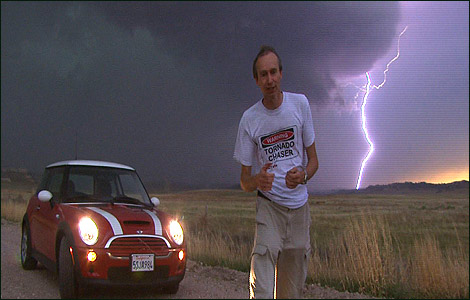 Alister Chapman: it's a mini adventure "We took shelter in the restaurant's deep freeze as this was the strongest part of the building.
"The electricity went off and we were plunged into darkness, some people started to scream and then it got very noisy and the building started to shake and creak. Within minutes it was all over." Alistair Chapman and his fellow storm-chasers then clambered out and watched the tornado swirl off into the distance - it had only missed them by half a mile. This was one of the many times when Alistair, a cameraman from Bracknell, travelled to Tornado Alley in the US - a hot spot in the central plains of the USA that covers a vast area from the Gulf of Mexico in the south to the Canadian border in the North. That day he'd just finished chasing storms and headed to a nearby restaurant, only to find that the storm hadn't quite finished chasing him.  Alister filming a tornado Regardless of this close shave, as well as a few others in his eight-year and 48-tornado career (once lightning struck within a few feet of him), Alistair has made it his life's work seeking what he lovingly dubs 'nature's fireworks'. "When you get close to the violent storms that you get in Tornado Alley in the spring you can feel the energy in the air," exclaims Alistair, a father of one. "When you look up you can see clouds swirling and whirling, you can feel the warm humid air that feeds the storm rushing in to it. It is an amazing opportunity to get very close to the full force of nature. At the same time your heart pounds and the adrenalin flows as you become very aware that you could be in deadly danger." Yet it's not the tornadoes themselves that pose the greatest threat. "Tornadoes are actually very predictable," he explains, "they will almost always travel in one direction and if you know what you are doing you can get very close quite safely." Rather, it's lightning that creates the biggest life-threatening risk as it can strike anywhere without warning, often miles away from a storm. "The storms we chase often produce a bolt of lightning every second". ____________________________________________ Find out more about stormchasing via Alister's website: The BBC is not responsible for the content of external websites ____________________________________________ So where did this fascination with thunderstorms and lightning begin? "When I was a child I remember watching a big thunderstorm while my mother took shelter under the stairs," recalls Alistair, who's a full-time self-employed cameraman, "since then I have been fascinated by severe weather.  It's behind you! "I saw the film Twister and thought that looked like fun, so I contacted some storm chasers in the USA and put together an idea for a TV programme. "I got a commission from National Geographic and spent a month in America filming storms and tornadoes and have been back every year since." Since then he's witnessed a flurry of violent tornadoes, the strength of which are measured using the Fujita scale. F0 is the weakest and F5 the strongest and is based on the amount of damage the tornado does. At F1 a tornado will break off tree limbs and may dislodge a roof tile. At F5 if a tornado hits a house there is nothing left by the concrete foundation slab. "The F4 tornado I saw was strong enough to completely flatten a well built house and toss a train a quarter of a mile," says Alistair. On April 30 he could well be witnessing even deadlier twisters. Alister is flying to Oklahoma City, at the very heart of Tornado Alley, to seek out the most violent storms on the planet. "I've seen 48 so far, so it would be nice to make it up to 50 this year. I am sure that there will be storms with lots of lightning, hailstones the size of golf balls and flooding rains. These are normal events in the spring in the US. He's also planning an expedition to Arizona in late July to try and film 'sprites' and 'blue jets'. These are strange and elusive bolts of energy that shoot out into space from the tops of extreme thunderstorms. "There is very little film of these and scientists don't really know what causes them," says Alistair.  Now if you're interested in storm chasing, clearly it's not a question of turning up in America and driving blindly to a storm in the hope of seeing something. "If you get it wrong, it could cost you your life," warns Alistair, who says a basic knowledge of meteorology is essential. An option is to join an organised tour such as ones run by Silver Lining Tours. And has he enjoyed any extreme weather conditions in Bracknell? "I have seen some pretty amazing lightning in and around Bracknell," says Alister. "There were some very strong storms last year and I enjoy watching nature's fireworks wherever they are." ____________________________________________ Find out more about stormchasing via Alister's website: The BBC is not responsible for the content of external websites last updated: 20/05/2008 at 14:14 Have Your SayAndrew Barber Jason monica smith Darren Clarke Toronto, Canada SEE ALSOYou are in: Berkshire > People > Your stories > Striking it lucky
|
| | About the BBC | Help | Terms of Use | Privacy & Cookies Policy |