|
 |
 | | | | | | ||||||||||||||||||||||||||||||||||||||||||||||||||||||||||||||||||||||||||||||||||||||||||||||||||||||||||||||||||||||
| | | You are in: UK: Education | ||||||||||||||||||||||||||||||||||||||||||||||||||||||||||||||||||||||||||||||||||||||||||||||||||||||||||||||||||||||||
|
| | Wednesday, 21 August, 2002, 16:58 GMT 17:58 UK Exam board pass rates vary 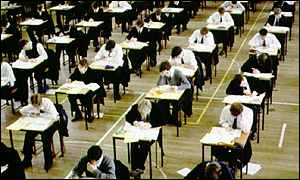 Schools can choose which boards they use
Exam performance can vary significantly between exam boards, with a difference of 10 points between the percentages getting top GCSE grades. As this year's GCSE results are released, previously unpublished figures show that last year, the proportion of entries achieving A* to C grades in English ranged from 57.1% to 67.3%, depending on which board's exams people sat.
A head teachers' leader thinks the difference might be explained by the fact that selective schools - with more academic pupils - tend to use one board over others. The exam boards say they are happy with the consistency of their papers. Across all GCSE subjects last year, the variation was from 55.5% to 72.4%. At A-level, the overall pass rate varied between 87% and 94.7%. Joint results This year's figures are not yet available - the exam boards decline to issue them yet, instead producing a collective average through their Joint Council for General Qualifications. It issued last week's A-level results and the GCSE results this week. The joint council, set up in January 1999, comprises the big English boards:
Unusually the WJEC does issue its own results - last week showing an A-level pass rate of 98.2%, whereas the overall rate was 94.3%. Last year the WJEC also had the best performance at A-level: 94.7%. CCEA was next on 94.5%, with AQA on 87%. In GCSE maths the variation was 46.3% to 74.3% - the Northern Ireland entries' achievements being the best, those from the English boards bunched much lower. 'Consistent' The convenor of the Joint Council for General Qualifications, John Milner, said there might be some differences because of such things as the number of students involved or the particular schools or colleges. "We are confident they are consistent results," he said. It is up to schools which boards they want to use. The "Welsh" board, WJEC, for instance, said that well over a third of its A-level papers this year were taken by students in England. The general secretary of the Secondary Heads Association, John Dunford, said schools were aware of the differences and did take notice of them. "Not as much as they used to, because I think the variation between boards is much less," he said - because they were "under the cosh" of the QCA exams watchdog to be consistent. Schools choose "People used to reckon that the old AEB was the easiest of the O-level boards whereas the Oxford and Cambridge was the hardest. "Now, you tend to choose more on the basis of the syllabus and what suits the teachers and students," he said. Dr Dunford thought the variation shown in the results could be explained by the quality of the candidates sitting the exams. Selective schools - with higher ability intakes - primarily chose the OCR board, he said. The AQA - which used to be the main northern England board - was used by fewer selective schools and thus got lower results on average. 'One board' Chris Stubbings, who runs the Campaign for One National Exam board, said: "It has long been known by those actually involved in the delivery of different syllabuses - as opposed to those monitoring such delivery - that there is a difference between the examination boards not just in terms of efficiency and resources but also in terms of standards. "The experienced teacher, on taking up a new post at a school may switch exam boards and suddenly achieve miraculous results." Having one national exam board would at the very least end the perception that there was a "soft option" board. | |
Internet links:  The BBC is not responsible for the content of external internet sites Top Education stories now: Links to more Education stories are at the foot of the page. | ||||||||||||||||||||||||||||||||||||||||||||||||||||||||||||||||||||||||||||||||||||||||||||||||||||||||||||||||||||||
| |
|  E-mail this story to a friend E-mail this story to a friend |
| |
| Links to more Education stories |
| | | ||
 | ||||
 | | Back to top
| ||
| ---------------------------------------------------------------------------------- To BBC Sport>> | To BBC Weather>> | To BBC World Service>> ---------------------------------------------------------------------------------- © MMIII | News Sources | Privacy |